
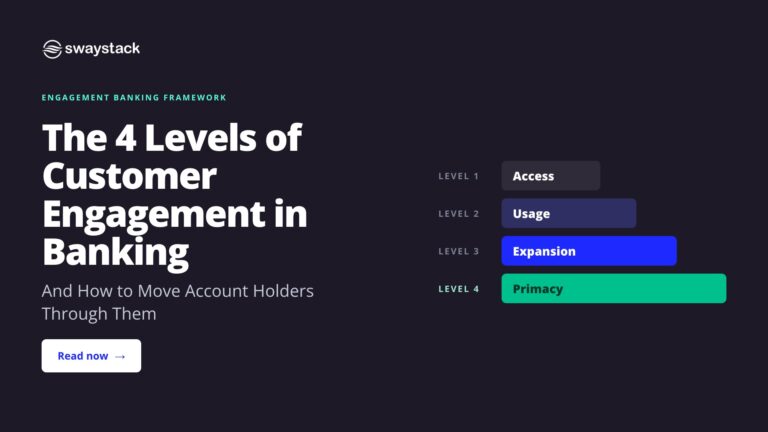
Almost every bank and credit union says customer engagement is a priority. Almost none of them can tell you where a given account holder sits within it.
That’s not a measurement problem. It’s a definition problem. Most institutions treat engagement banking as a single state — engaged or not engaged — instead of what it actually is: a progression. New research from Cornerstone Advisors, commissioned by Swaystack, puts numbers behind why that distinction matters: highly engaged consumers hold six or more products with their primary institution 42% of the time. Unengaged consumers hold that many just 3% of the time.
The gap between those two numbers is the entire business case for digital engagement. But you can’t close it without knowing which of the four levels your account holders are stuck at — and what specific action moves each one forward.
What Is Customer Engagement in Banking?
Customer engagement in banking is the series of interactions that deepen how integrated a bank or credit union becomes in someone’s financial life — moving from opening an account to making it the place their financial life happens.
It’s not a feeling, and it’s not a survey score. It’s behavioral: things account holders do that you can see, influence, and count.
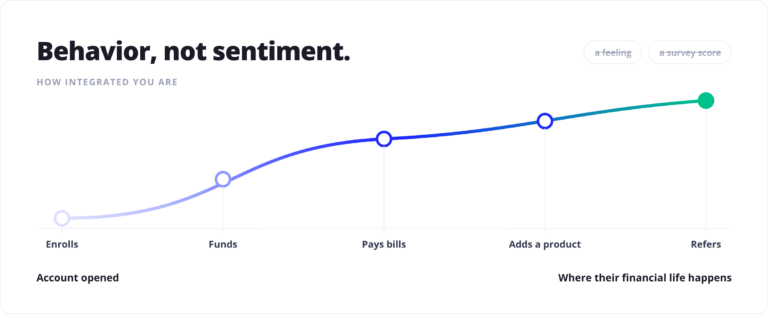
That definition matters because it turns engagement into something you can actually manage. If you can’t measure it, you can’t improve it. And if there’s no clear path from one level to the next, “engagement strategy” is just a slogan sitting on top of scattered tactics—an onboarding email here, a re-engagement push there —with no connective thread.
The Four Levels of Customer Engagement
Account holders don’t flip from “unengaged” to “engaged.” They climb — or stall — across four levels. The first three are behavioral: things your institution can drive by removing friction. The fourth is attitudinal: a decision the accountholder makes, not a switch you flip.
Level 1: Access — Can They Even Get In?
Access is the entry point. The account is opened, digital banking is enrolled, the app is downloaded. It’s necessary, but it’s not engagement yet — an accountholder who enrolls and never logs in again is no further along than one who never enrolled at all.
How to spot it: Look at the gap between the triggering event (account opened, loan booked) and digital banking enrollment. One credit union found indirect auto borrowers were taking 14 to 15 days to enroll — and many never did, because registration required a member number they didn’t have and would never use.
What moves them forward: Find the credential or verification step blocking enrollment, and remove it. That one credit union built a personalized registration link that let borrowers enroll with just a date of birth and Social Security number. Enrollment time dropped from two weeks to about four days. Advancement at this level is almost always the same move: find the friction, engineer it out.
Level 2: Usage — Have They Built a Habit?
Usage is where the account becomes a place someone actually goes to do things. The debit card gets activated. Bills get paid. The account gets funded beyond the minimum.
How to spot it: Watch for the enrolled-but-inactive accountholder — logged in once, never came back. Watch for the account funded at $25 that’s still sitting at $25 six months later. That’s not a dormant account. That’s a Usage problem about to become an attrition problem.
What moves them forward: Put the next usable action directly in front of them, inside the app. Account funding is often the highest-leverage move here — it’s the action a brand-new account holder is ready to take, well before they’re ready to move a paycheck or set up bill pay. Make the next transaction one tap away from wherever the accountholder already is.
Level 3: Expansion — Is the Relationship Widening?
Expansion is where the relationship grows across products. This is the behavioral ceiling — account holders will open a second or third product on the strength of a good rate or a smooth experience, long before they’ve decided your institution is their financial home.
How to spot it: Look for account holders whose activity looks like a multi-product relationship even though their product list doesn’t match it — the checking account holder who’s in the app daily but carries a loan somewhere else. That’s a customer doing more financially than the products they hold with you would suggest.
What moves them forward: Put a relevant, pre-qualified offer directly in the channel, and let them accept it there. Pre-approved loans presented and accepted entirely inside digital banking consistently outperform anything requiring a phone call or a branch visit. Expansion responds to friction removal because the accountholder is already willing — your job is making the next product one click away.
Level 4: Primacy — Have They Chosen You?
Primacy is different from the three levels below it. Access, Usage, and Expansion are behaviors you can drive. Primacy is a decision the accountholder makes: this institution is where I run my financial life.
You can’t engineer that decision the way you engineer an enrollment link. It’s earned — through a good first-product experience, an app that’s actually reliable, and the steady absence of reasons to look elsewhere.
How to spot it: The fingerprint of primacy isn’t any single transaction — it’s a pattern. Bills paid here. Debit card used regularly. Money moving in and out through P2P transfers. Referrals sent. That combination signals someone has decided to put down roots, not just pass through.
One thing worth knowing: direct deposit is not the reliable primacy signal most bankers assume it is. Only 47% of consumers cite it as a reason they consider an account primary — and among Gen Z, that number drops to 35%. A growing share of account holders route their paycheck into an account that isn’t the one they actually use day-to-day. The paycheck lands in one place. The financial life happens somewhere else. If you’re chasing direct deposit as your primary engagement KPI, you may be optimizing for the wrong behavior with an entire generation of account holders.
What moves them forward: Earn the decision through experience, then clear the mechanical friction once the accountholder is ready to commit. This is the one level where a good app and a good product matter more than a good nudge.
Why the Four Levels Matter More Than a Single Engagement Score
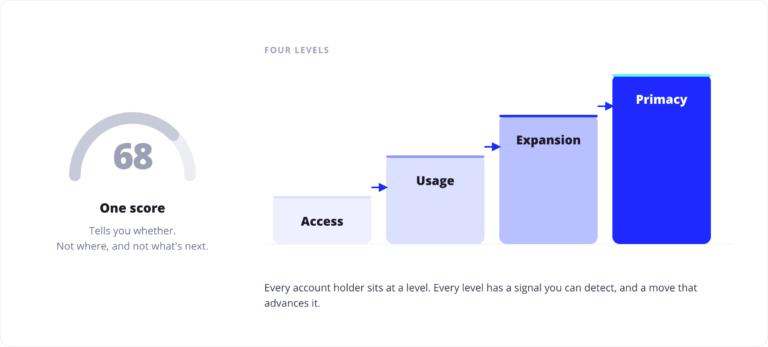
A single engagement score tells you whether someone is engaged. It doesn’t tell you where they’re stuck or what to do about it. The four levels turn engagement from a scorecard into an operating model — every accountholder sits at a level, every level has a detectable signal, and every transition has a specific move that advances it.
That’s the difference between an engagement strategy and an engagement tactic. Tactics are things like an onboarding email sequence or a 30-day-inactivity push notification. A strategy is a deliberate answer to a harder question: who are we trying to move, from which level to which level, and through what specific action?
Not Every Accountholder Climbs the Same Way
One caution: these four levels describe a single ladder, but not every accountholder climbs it the same way, at the same pace, or to the same ceiling. A rate-driven CD holder who’s entrenched at another institution may top out at Usage no matter what you do. A digital-native accountholder might skip straight past Access because they arrive already wanting the app. Knowing the realistic ceiling for each segment tells you where to invest — and where you’re wasting effort on account holders who were never going to climb further.
FAQ: Customer Engagement Banking Framework
What are the four levels of customer engagement in banking? The four levels are Access (the accountholder can transact digitally), Usage (they transact regularly), Expansion (the relationship widens across products), and Primacy (they’ve decided your institution is their financial home). Each level has its own detection signal and its own advancement action.
What’s the difference between digital engagement and customer engagement in banking? Digital engagement typically refers to activity inside digital channels — logins, app usage, feature adoption. Customer engagement is broader: it’s the full progression from account access to primacy, and digital behavior is simply the clearest window into where an accountholder sits within it.
Is direct deposit a reliable sign of a primary banking relationship? Not anymore, and increasingly not for younger consumers. Only 47% of consumers overall cite direct deposit as a reason they consider an account primary, and that number is lower still among Gen Z and Millennials. Repeated, varied activity — bill pay, debit card use, P2P transfers — is a more reliable signal of primacy than where a paycheck lands.
How do you measure customer engagement in banking? Measure it as a progression, not a single score. Track how many account holders move from Access to Usage, from Usage to Expansion, and from Expansion to Primacy — and track how many stall at each stage. Activity metrics like logins and email opens tell you what your institution did. Progression tells you what the accountholder actually did as a result.
Where This Comes From
This framework comes from Engage to Grow: Designing the Behaviors That Build Better Banking Relationships, a report Cornerstone Advisors produced based on interviews with bank and credit union executives managing engagement platforms in production. It’s the most complete look yet at what’s actually working — and what isn’t — in banking engagement strategy.