
Watch the full episode here.
An account can pass every test on your dashboard and still be walking out the door.
It shows a transaction this month. It hasn’t been flagged inactive. Nobody’s called about closing it. By every standard measure, it’s active. And yet the account holder’s paycheck landed elsewhere, most of the balance moved out within days of arriving, and the debit card hasn’t left a drawer in months. The account is open. The relationship is gone.
That’s silent attrition — and it’s a bigger threat to a portfolio than the accounts that never got funded in the first place, because nothing in your standard reporting tells you it’s happening.
What Is Silent Attrition?
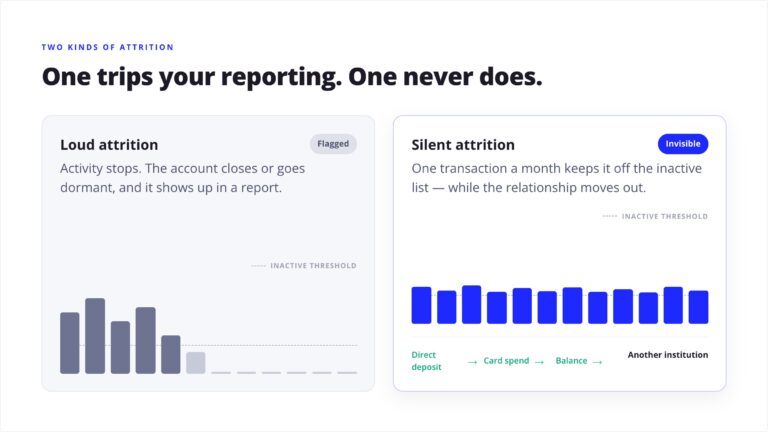
Silent attrition occurs when an account remains technically active while the underlying relationship moves to another institution. No closure request. No support call. No line item in a monthly attrition report. The account holder hasn’t left — they’ve just stopped treating your institution as home.
Most activity monitoring is built to catch the obvious version of attrition: an account that goes dormant, or one that’s formally closed. Silent attrition doesn’t trip either wire. A single transaction a month is often enough to keep an account off the inactive list, even if that transaction is the only sign of life the account has.
Loud attrition looks like an account closing or going fully dormant, and it shows up in a report.
Silent attrition looks like: an account stays open and “active” by the loosest definition, while direct deposit, card spend, and balance all drift toward a different institution.
The second one is far more common — and far harder to see.
The Three Signals That Separate Primary From Parked
You don’t need a new dashboard to start finding it. You need to ask three questions about the accounts you already have.
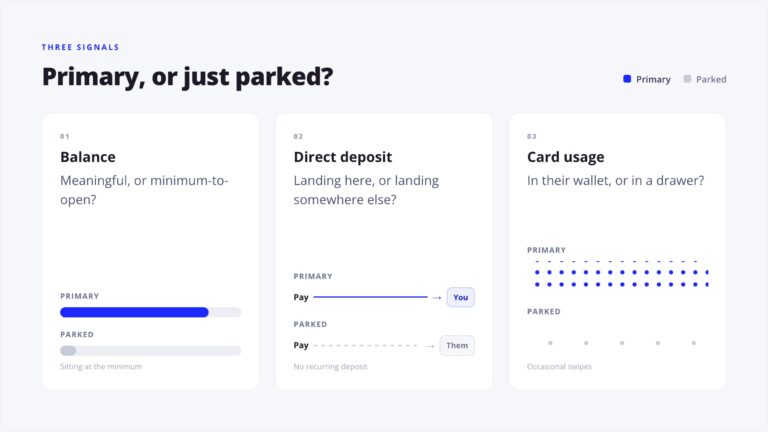
Is the balance meaningful, or minimum-to-open? An account sitting at the minimum required balance months after opening isn’t a funded relationship — it’s a placeholder. The account holder has other funds; they’re just not here.
Is direct deposit landing, or landing somewhere else? Direct deposit is the closest thing to a definitive primacy signal available. If a paycheck isn’t hitting the account, or only a fraction of it is, the account holder’s real financial home is elsewhere — no matter what the account status says.
Is the card the one in their wallet, or the one in a drawer? Card usage is a proxy for daily habit. An account with occasional, low-frequency swipes isn’t the account someone reaches for at checkout. It’s backup.
Run those three questions against your portfolio, and “active” starts to look like a much smaller category than your reporting suggests.
Why This Hides in the Existing Base, Not Just New Accounts
Most onboarding efforts are aimed at the first 30 to 60 days after an account opens — for good reason. That window does the most to determine whether an account becomes primary or becomes a placeholder.
But the bigger blind spot isn’t the new accounts. It’s the ones opened six months, a year, three years ago that have quietly drifted toward secondary status since — with no onboarding process still watching them, because onboarding was never designed to run past day 60.
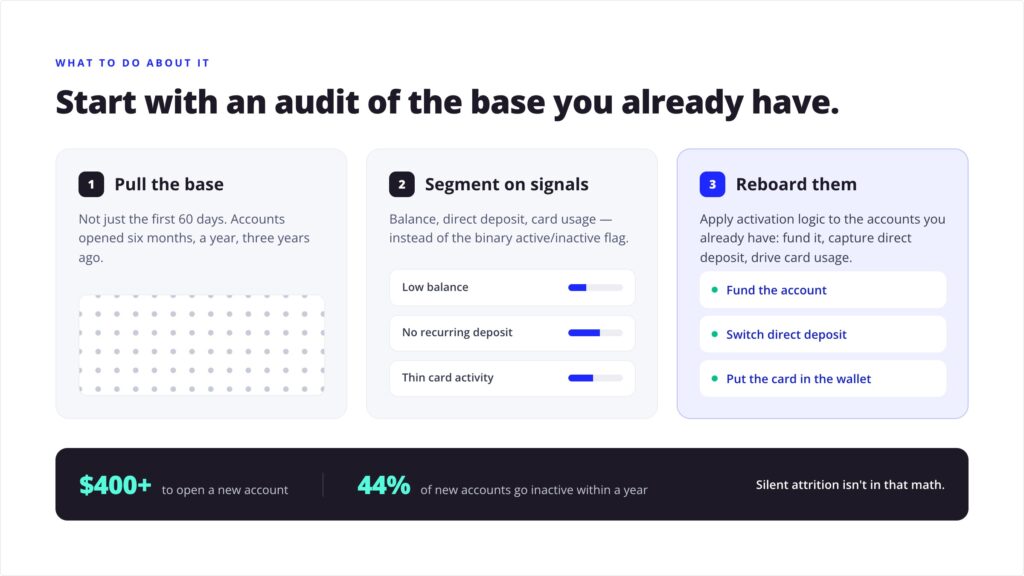
This is where reboarding comes in: applying the same activation logic — fund it, capture direct deposit, drive card usage — to the existing base, using data the institution already has. Low-balance accounts, accounts without recurring deposits, and accounts with thin card activity are all identifiable today, without new infrastructure. The data to catch silent attrition already sits inside the core and the digital banking platform. Most institutions just aren’t segmenting it that way.
The Cost of Not Seeing It
The visible cost of account inactivity is well documented: opening a new account costs an institution more than $400, and nearly 44% of new accounts go inactive within the first year. That math alone makes the case for a strong first 60 days.
But silent attrition is the cost that math doesn’t capture. An account that shows monthly activity won’t appear in an inactivity report, won’t trigger a win-back campaign, and won’t get flagged by anyone — even as the balances, deposits, and spend that made it valuable move to a competitor. The $400 acquisition cost was paid in full. The return on it just never showed up, and nothing in standard reporting says so.
What To Do About It
Start with an audit, not a new tool. Pull the existing base and segment it against the three primacy signals — balance, direct deposit, card usage — rather than the binary active/inactive flag most systems default to. That segmentation alone will surface a category of accounts that looks fine today but is at real risk of disappearing within a year.
From there, treat primacy as something built deliberately, not assumed. An account that meets the minimum bar for “active” hasn’t earned primary status — it’s just cleared the lowest bar your systems check.
This is exactly the gap Har Rai Khalsa, co-founder and CEO of Swaystack, digs into with Jim Marous on a recent episode of Banking Transformed — including the specific numbers institutions have seen from closing it: portfolio-wide lifts in direct deposit, deposit balances, card usage, and digital banking logins, all from treating the existing base as seriously as new accounts.
Listen to the episode: Why Half of New Bank Accounts Go Dormant in Year One →
FAQ
What is silent attrition in banking? Silent attrition occurs when an account remains open and technically “active” while the account holder’s primary financial relationship — direct deposit, spending, balances — shifts to another institution. Because the account still shows some activity, it doesn’t get flagged by standard inactivity reporting.
How is silent attrition different from account dormancy? Dormancy is loud: an account stops showing activity altogether and gets flagged. Silent attrition is quiet: the account shows just enough activity to stay off the inactive list, even as the real relationship moves elsewhere.
What signals indicate an account has gone from primary to secondary? Three signals matter most: whether the balance is meaningful or sitting at the minimum, whether direct deposit is actually landing in the account, and whether the debit or credit card shows regular use. Weakness across all three usually means the account has become secondary.
What is reboarding? Reboarding applies onboarding-style activation — driving funding, direct deposit capture, and card usage — to an institution’s existing account holder base, using transactional data the institution already has, rather than only focusing on accounts in their first 30 to 60 days.