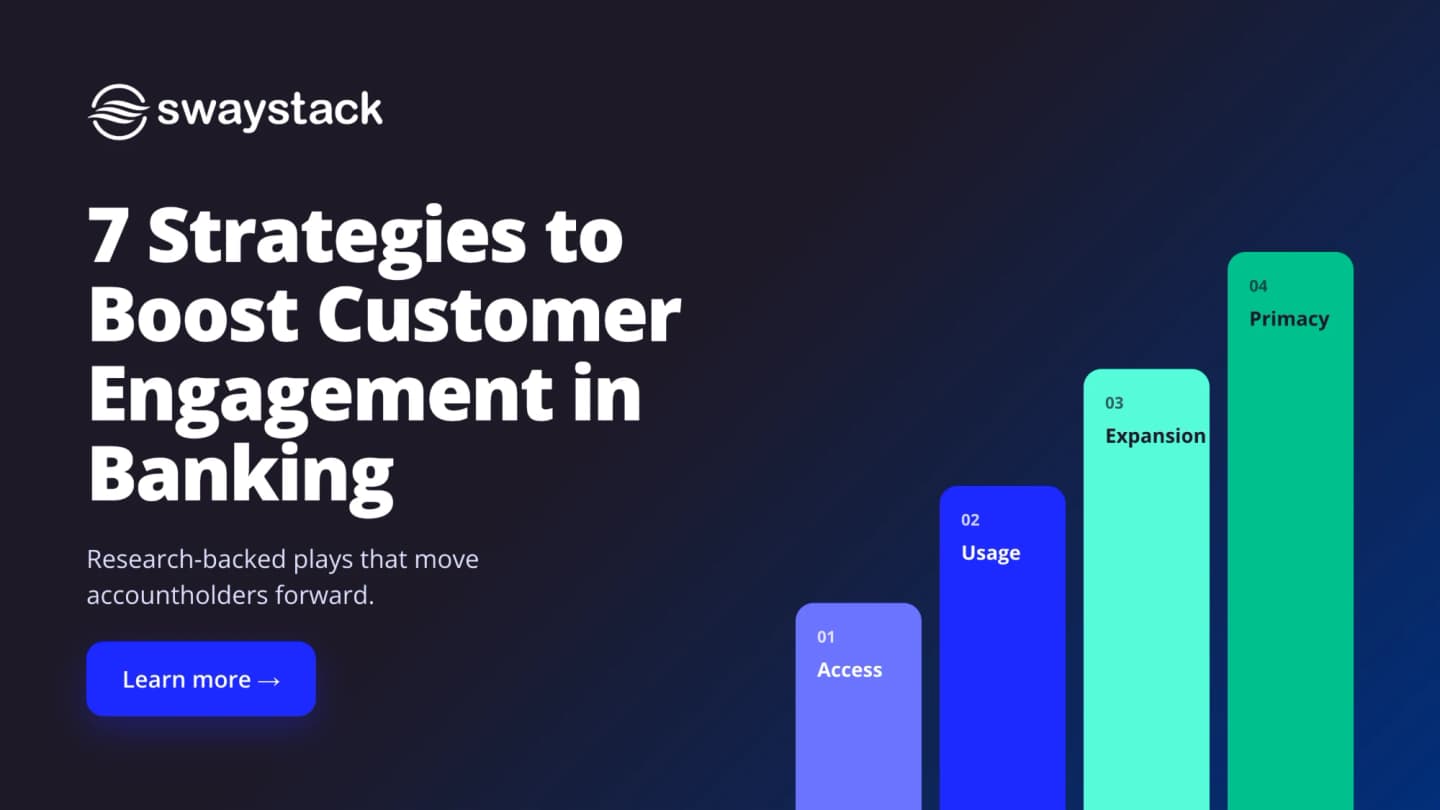
New research from Ron Shevlin and the Cornerstone Advisors team, commissioned by Swaystack, found the difference comes down to a handful of specific habits: not budget, not headcount, not a bigger tech stack. Institutions getting real results define engagement as something measurable, assign clear ownership across departments, and match the right play to the right account holder at the right moment.
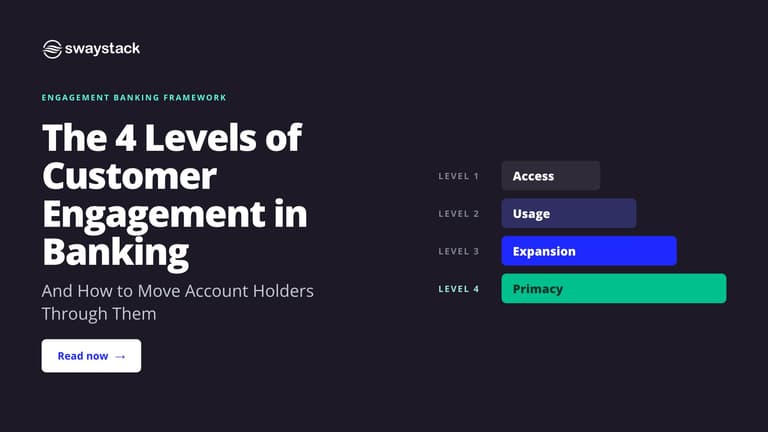
Here are seven strategies pulled directly from that research. (If you haven’t already, our last post covers the four-level framework these strategies are built on.)
1. Define Engagement as a Behavior, Not a Feeling
Ask five people at the same institution what “engagement” means, and you’ll likely get five different answers. That’s not a semantic exercise. It’s the reason engagement programs stall. Without a shared definition, no one is wrong, and no one is accountable for moving the number.
The fix is simple but often skipped: define engagement as a series of observable behaviors (account funded, debit card activated, direct deposit switched), not a feeling, a survey score, or a vague sense that “usage is up.” If you can’t measure it, you can’t manage it.
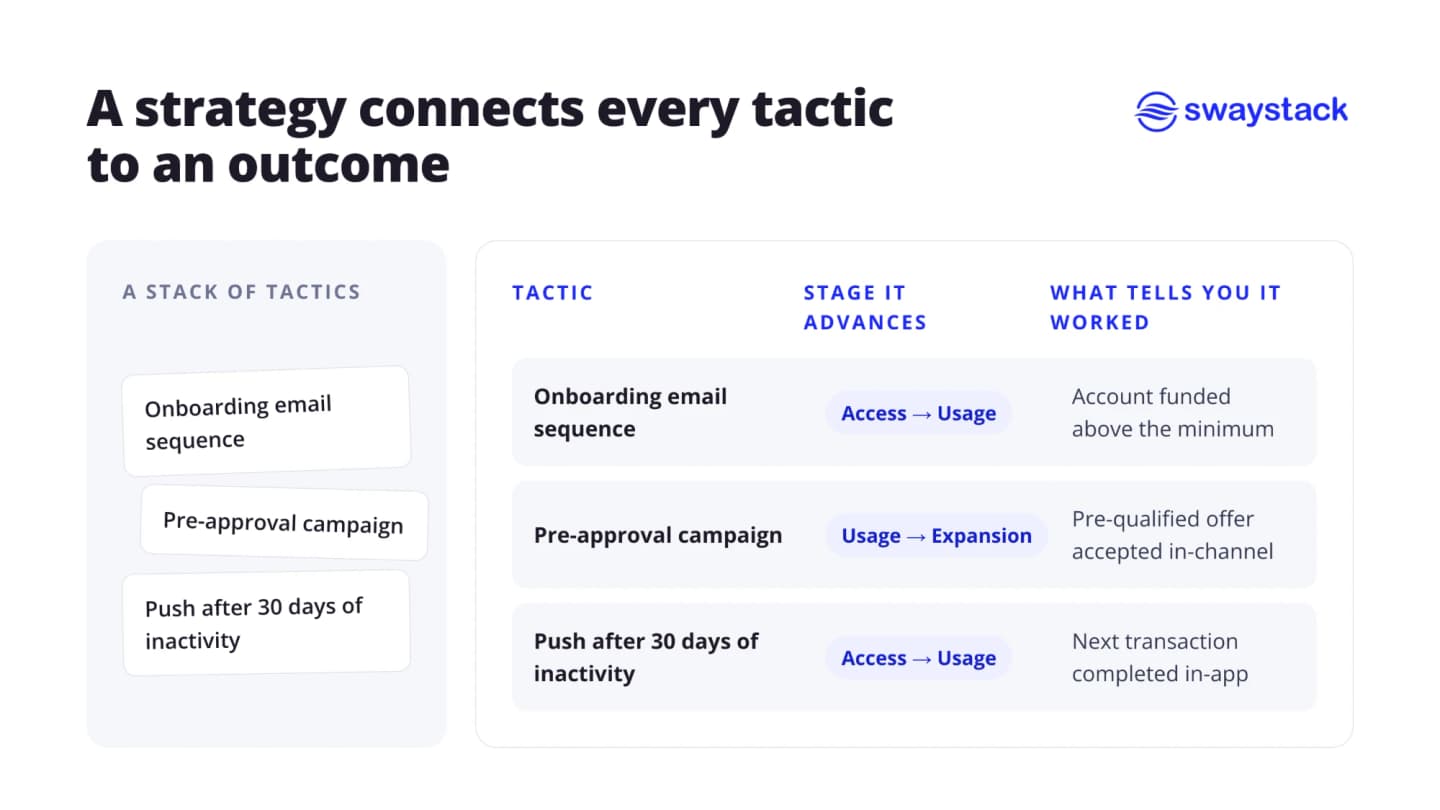
2. Build a Strategy, Not Just a Stack of Tactics
An onboarding email sequence is a tactic. A pre-approval campaign is a tactic. A push notification that fires after 30 days of inactivity is a tactic. None of them, on their own, answer the real strategic questions: who are we trying to move, from which stage to which stage, and through what specific action?
A strategy connects every tactic to an outcome. Before launching another campaign, ask what stage of the relationship it’s actually meant to advance, and what would tell you it worked.
3. Assign Ownership Across the Handoffs
Most institutions treat account opening, onboarding, cross-sell, and retention as separate processes, run by separate teams, measured against separate KPIs. Account holders don’t experience it that way. To them, it’s one continuous relationship. The friction that matters most tends to sit exactly at the handoffs between departments, which is also where it’s least likely to have an owner.
A marketing team can run a flawless onboarding sequence and still watch accountholders stall because a fraud-resolution process three departments away takes over a week to clear a legitimate transaction. Marketing can’t fix that on its own. Someone needs explicit, cross-functional authority over the entire journey, not just their piece of it.
4. Match the Play to the Transition
Once ownership and definition are in place, the plays themselves are straightforward. Every transition between engagement levels has one detectable signal and one advancement action:
5. Sequence Enablement Before Cross-Sell
Order matters more than most institutions treat it. Enablement actions (enroll, fund, activate) need to come before cross-sell actions like upgrades and loan offers. Asking an accountholder to consider a new product before they’ve even activated their debit card is asking for a bigger decision before you’ve earned a smaller one.
The strongest-performing institutions sequence their asks deliberately: easy, relationship-building behaviors first, revenue-generating behaviors second.
6. Segment by Realistic Ceiling, Not Just Product Count
The same play doesn’t produce the same result on every accountholder, and treating everyone identically wastes effort in both directions. A financially healthy, multi-product accountholder can climb the entire ladder toward primacy. A rate-driven CD holder already entrenched at another institution may top out at Usage no matter how good your Expansion play is.
Knowing each segment’s realistic ceiling tells you where the investment actually pays off, instead of running the same nudge against accountholders who were never going to climb further. Entry points differ too: a relationship-seeking accountholder often arrives already wanting checking and the app, effectively starting near Usage, while an indirect borrower starts below Access with no relationship yet at all.
7. Don’t Build Your Primacy Strategy Around Direct Deposit Alone
This is the strategy most likely to be wrong today, and it’s worth getting right. Ask a banker to name the strongest signal of a primary relationship, and most will say direct deposit. For a large and growing share of accountholders, that’s no longer true.
Only 47% of consumers cite direct deposit as a reason they consider an account primary, and the number drops sharply by generation: 47% of Gen X, 41% of Millennials, and just 35% of Gen Z. Many younger consumers hold multiple checking accounts and route their paycheck into the one they don’t actually use day to day. The deposit lands in one place. The financial life happens somewhere else.
A strategy built entirely around capturing direct deposit over-indexes on older accountholders and misses a growing share of younger ones, who signal primacy through money-management behavior (budgeting tools, credit-score features, P2P activity) instead. Segment this play by generation, not just by product count.
Putting It Together
None of these seven strategies require a bigger tech stack. They require a shared definition, clear ownership, the right play in the right sequence, and a willingness to segment instead of applying one playbook to everyone. That combination separates institutions proving engagement works from those still guessing.
Where This Comes From
These strategies are drawn from Engage to Grow: Designing the Behaviors That Build Better Banking Relationships, a report Cornerstone Advisors produced based on interviews with bank and credit union executives running engagement platforms in production.
FAQ: Strategies to Improve Customer Engagement in Banking
What are the best strategies to improve customer engagement in banking? The strongest strategies share a few traits: a clear, behavior-based definition of engagement, cross-functional ownership across account opening, onboarding, cross-sell, and retention, a specific advancement play for each stage of the relationship, and segmentation by accountholder type rather than a single playbook applied to everyone.
Why do most FI engagement strategies fail? Most institutions run engagement tactics (an email sequence, a push notification) without a strategy connecting them to a specific outcome. Without a shared definition of what engagement means and clear ownership across departmental handoffs, individual tactics don’t add up to measurable progress.
How should institutions sequence their customer engagement strategy? Enablement actions should come before cross-sell actions. Get accountholders enrolled, funded, and using their debit card before asking them to consider a new product or loan offer. Institutions that reverse this order tend to see lower acceptance rates on cross-sell campaigns.
Is direct deposit still the best measure of a primary banking relationship? Not for every segment. Only 47% of consumers overall cite direct deposit as a driver of primary status, and that drops to 35% among Gen Z. A more reliable, cross-generational signal of primacy is repeated, varied activity (bill pay, debit card use, P2P transfers) rather than where a paycheck happens to land.